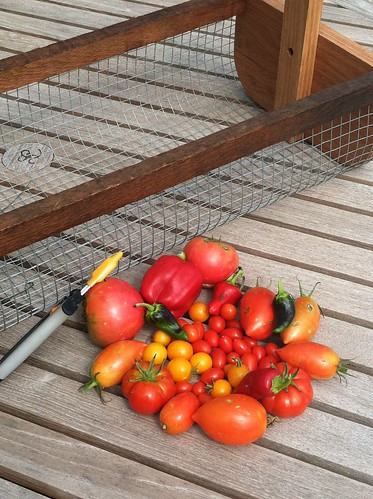
Admittedly, it's not a burying windfall. There was plenty of room left in the basket. Nonetheless it was good to spend the morning getting reacquainted with the garden after an extended weekend away. More, really, because showers throughout the preceding days had seduced me into leaving the seedlings to their own quiet growing while I attended to matters outside the fence. A generous neighbor agreed to monitor the thirst of the intervening days, so I knew the project was in good hands. Still, like a parent leaving young ones with a babysitter, it was good to get back home and behold their well-being with my own eyes.
In the cool of the morning, heavy with dew, I made my way out and through the gate. Indeed, all was well, though the plants seem to be "between times." Recent seedings are only barely peeping through the soil, and the tomatoes seem pretty well exhausted. The peppers, while not heavy with fruit, are popping with new blossoms; a premonition of spiciness to come. The rest are on their way or holding their own, contentedly filling their spaces.
I strapped on the knee pads and started a fresh circuit confronting weeds in the first half-dozen trenches, and then browsed the rows for ripeness. There were, as the picture attests, a few offerings to bring inside -- a kindly, if humble, gesture as though to say, "welcome home."

Seeking depth and nourishing strength
Monday, August 20, 2012
Monday Harvest

Tuesday, August 14, 2012
Repent, Recant, and Regard Afresh the Gift
"To be a greedy gardener seems somehow offensive. What I get from the garden I like to regard as a gift. Nature and I have cooperated. Though when we have summers of drought, then summers when it rains daily for six weeks and the garden is a swamp, I feel angry, cheated. Who's cooperating here? This is my garden! Not my chief source of food, it's true, but the food I most covet and hoard in the deep freeze for the worst of winter nights, an essential ingredient of the life we've made for ourselves here."So I have slept on my desultory feelings regarding yesterday's potato harvest, and feel the need to repent. Tall is right in her observation captured above: greed in a gardener is, indeed, offensive. That anything emerge at all -- meager or abundant -- is, indeed, a gift. Especially for me. If this garden is a cooperative effort between Nature and me, then I can only acknowledge receiving the more enviable share. Nature, in my helping hands, gets the shorter end of the bargain. True, I am attentive -- to a fault. True, I am protective. True, I am eager to learn. But this latter is an extraction rather than a contributive asset. It carries within it the hope of future capacities, but speculative tomorrows offer little consolation to the deficits aching today.
-----Deborah Tall, From Where We Stand: Recovering a Sense of Place, p. 150
Grace, then, anything this garden manages to deliver this year -- gift and grace. So I recant my tomato critiques and potato belittlements; recant, as well, my disparagements of the collards' slow pace and the beets' indifference to my schedule. They are all alive and growing and offering up something of themselves, even if it's not what I pictured in February from the comfort of my recliner. Their capacity to survive at all in the worst heat and drought in decades -- along with my clumsy ministrations -- should, if anything, inspire wonderment and awe, rather than this gratitude squeezed with as much parsimony as I have accused the garden itself of offering.
So, yet another lesson learned. This is real life, not the glossy photographs in the seed catalogs. And however uneven the partnership, Nature and I have cooperated. Just this morning I tilled up the now-empty potato trenches and scattered a few more left over seeds. Let the partnership continue!
And come that "worst of winter nights" when I reach into the deep freeze -- or the shelf of canned produce -- this will be the food I most covet and hoard, not simply for the gift of it, but this year for the miracle of it existing at all.
Truly a blessed and "essential ingredient of the life we've made for ourselves here."
Monday, August 13, 2012
Eyes Under Ground
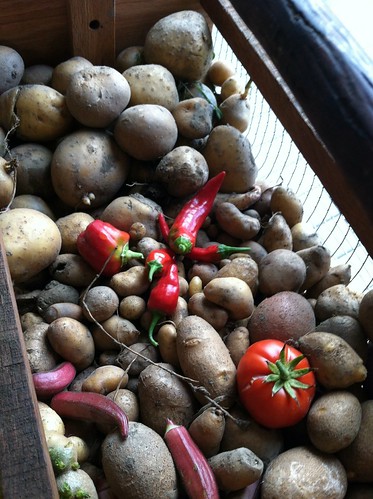
Back in May I planted three types of potatoes: French Fingerling, left over from last season; Yukon Gold purchased at the local farm store, and basic Russets, gone to sprout in my Mother-in-law's garage. I cleared the trenches, scattered in the seed potatoes, covered and waited. Along the way, they actually sprouted (I am always surprised by such things), blossomed, and...well, that's the mysterious part. After the blossoms it's hard to know exactly what else might be going on beneath the surface.
On faith, then, I weeded and watered and watched and waited. For the past two weeks I have thought to dig them up, believing -- for reasons I can't quite put my finger on -- that it was "time." I was supposed to have help today, but that fell through. No worries, however. I rather enjoyed the discovery process, and it didn't turn out to be that much work.
Which is a coy way of saying there weren't that many potatoes to dig.
I started with the Fingerlings; pitch-fork loosening the soil, then hands and knees and fingers making my way along the trench. I will say this: if there were an award at the State Fair for the smallest potato there would be a blue ribbon in my future. There are certainly nice sized ones, but my heavy harvest in this category this year is less the size of the eponymous finger and more along the dimensions the lentil -- half a dozen or so to the mouthful.
On to the Yukon Gold, results were a little more impressive -- golden golf balls and slightly smaller unearthed in this partial trench abutting the now-vacated garlic bed.
To be sure, I had the least invested in the Russets, which turns out to be a good thing. They were the most disappointing producers -- the harvest barely replacing the eyed chunks I had buried in the beginning.
I have more reading to do on the finer art of potato cultivation, despite the "any boob can grow potatoes" reassurance proffered by my preliminary inquiries. This boob's efforts would barely rate a C- by any objective assessment, although the 15 pounds or so I weighed in with isn't a total embarrassment. Besides, I am sure they will make up in taste what they lack in volume. Right.
Postscript: Click here for a panoramic view of the garden. The image, which takes a moment to fully load, will open in a new window. Click and hold your mouse button anywhere on the image, then drag the photo from side to side to see the full scene.
Thursday, August 9, 2012
With an Eye and an Appetite for Next Year
Perhaps it is the inch and half rain that fell yesterday, affording a delightful respite from the hose.
Perhaps it is the thorough weeding accomplished earlier in the week.
Perhaps it is the brief interval between harvests since Tuesday's aggressive gleanings of okra, tomato and cucumber and the grand pickling that night.
Whatever the justification, and with nothing from the garden really calling, I indulge a second pot of coffee, settle down to the computer and...order more seeds.
Garlic, actually. Which won't be shipped until October.
It's strange to think about next season. I've just begun to pick squash, and the okras have a long way to go before they are exhausted. I clipped the first of what I hope will be many leaves of swiss chard, and the potatoes are still in the ground. There are yet tomatoes and tomatillos and peppers of several varieties, and the basil is patiently waiting for its turn in the pesto kitchen. Who knows when the beans will be ready to harvest and shell, and whether or not the beets will actually offer anything other than tops. The fall crop is only half planted, with half a dozen seed packets queued up and waiting. Next season?
The fact is that garlic requires advance attention. I barely beat the deadline last fall with a late November planting. Better to nestle the cloves into place before the end of October. And purveyors tend to run out of supplies early in the fall. Already one of my preferred providers is sold out of two desirable varieties. It's important to order early. And I learned the hard way that in this first go-round I planted far too little. Saving back a few heads for next season, we have already gone through much of the harvest.
And I never wanted to be a one-hit wonder. Peas produce once and then are done; I want to be a recurring, perennial producer. There will be a Season #2.
Still, it's barely August and Season #1 is still in process. It is with a curious mixture of embarrassment and titillation that here in the throes of summer I straddle the entire girth of autumn and winter and plant a foot so proleptically in spring. But I can already almost taste it.
Here, then, is what's in store:
| Erik's German White |
 |
| Lorz Italian |
 |
| Georgian Fire |
 |
| German Extra Hardy |
 |
| Inchelium Red |
 |
| Music |
Tuesday, August 7, 2012
Invaders
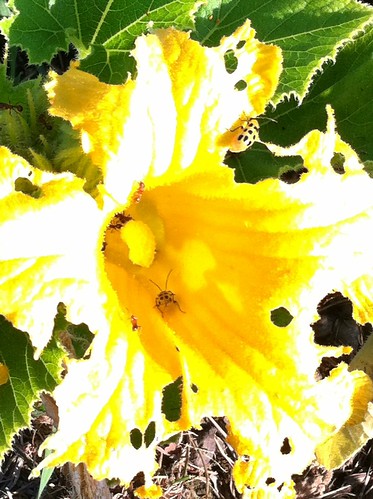
Curiously, they seem confined to the pumpkin plants. Studying up, I've learned that squashes are most susceptible to worm-like vine borers and squash beetles, but this critter doesn't look like either one. In fact, the closest I have come to an identification is the "spotted asparagus beetle." You be the judge. The small inset picture is the textbook example.

If that ID is correct, they seem to have lost their way. I spent part of the morning weeding the asparagus trenches and found them completely beetle-free -- except for the occasional song on my iPod playlist by the fab four
Because I haven't heretofore been confronted by such invaders this summer I had to excavate my spray bottle of organic homemade pesticide left over from last summer. In the ensuing year, the mixture of vegetable oil, dish soap and water had separated of course, and shaking the ingredients together only manufactured an unsprayable foam, so I unscrewed the top and splashed the horticultural meringue over the offended blossoms. We'll see.
In the meantime, it will pay to keep watch. Add this to the already lengthy list of enterprises and growing organisms that don't prosper while on auto-pilot. Most things of value, I am constantly being reminded, benefit from loving attention.
Monday, August 6, 2012
Cracked skin

You might think there would be a cream for this. Perhaps Estee Lauder or Lubriderm simply haven't thought about the horticultural prospects yet. I can tell them that are potential profits rotting out there in the garden. Cracked skin, as it turns out, isn't confined to faces and hands.
It has been a sobering disconcertion. All season long I have quietly tended, looking forward to an inundation of ripe tomatoes. From greenhouse seeding to garden weeding I have been present, watchful, and ready with the hose. The weather, after all, has been challenging. Everyone I meet commiserates pityingly over my misfortune of starting this new garden in this particular year -- what with the choking drought and the record setting heat. I usually reply that it might be good to start at the bottom. I might even believe it.
But now as the green orbs redden or orange, and I withhold my plucking hand for the perfect moment of ripeness, I discover upon closer inspection the chasmic wounds marring more of the harvest than seems fair.
Sure, there are plenty of beauties, and I treasure them. But there are all those others. To be sure, for many the marring is merely cosmetic, but in others the cracks have actually opened the flesh and baited the ants and their kin who have burrowed and gnawed and defamed.
It turns out -- and this really comes as no surprise -- it is likely my own fault. Sure, the high heat could be a factor according to one guide. But the likelier culprit is over-watering and under-fertilizing.
Ironic, I think, that my zealous ministrations with the hose might have been the undoing of a material percentage of the crop. That, while paying inadequate attention to basic nourishment.
Perhaps it is a little like an overprotective father, perpetually standing too close so as to deflect any potential harm, while providing little more than cotton candy for supper.
Well, I started this project in order to learn. Lesson #1: a little tough love can go a long way.
Wednesday, August 1, 2012
Paying A Different Kind of Attention
By this point it seems like a long time ago. Last September we moved to this property with a household's worth of packed boxes and a vision, excitement and more than a little apprehension over the implications of what we had done. Less than a year -- not so long when measured by the calendar, but an eon , all else considered. In the intervening months we have trimmed trees, cleared brush, planted trees, built a greenhouse, commissioned and planted a sign, designed a garden, ordered and planted seeds, cleared the target area, dug trenches, staked and strung a fence, and planted. Planting gave way to watering, weeding, weeding and watering, contending with rabbits, adding more fence, weeding and watering, watering and weeding, waiting and watching, watering and weeding. And weeding and watering.
There develops, in the practice of it all, an almost drone-like character to the tending -- a rhythmic, centering monotony only occasionally interrupted by a brief rain or a schedule conflict. Watering, weeding, observing the growthful progress. There was a certain giddiness over the progression from stem to leaf to flower to bud and finally that blush of color. But still there was the drone -- the weeding, the watering, the studious observation and the waiting.
There was that delicious euphoria at the first tomato plucked and the companion pepper snipped. But it doesn't pay to overly indulge in self-congratulation. A garden, I have learned, is like a river -- always moving, always in motion; a glacier, more like it, given the almost imperceptible pace, but moving nonetheless.
And the drone, I have discovered, is hypnotic. I get out early to preempt the heat, barely shaking off the sleep, yank the standpipe's handle, will my palm into compliance with the shape of the hose, and set about the routine. The drone buoys me along the paces, watering and then weeding, noticing.
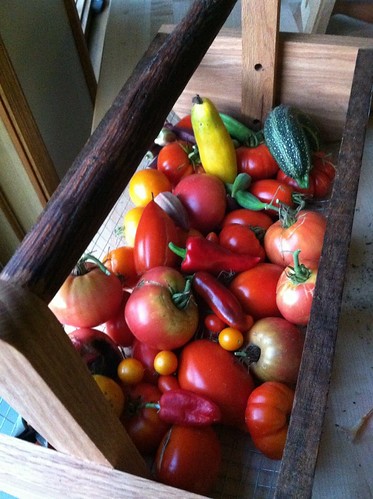
Suddenly I realize I am missing something important: the harvest. After those initial offerings, I have slipped back into routine, forgetting the "moreness" still and inexorably ripening -- the payoff of all the effort.
So each day now I remind myself to actually pick something -- to allow myself a momentary arrival in the midst of this ongoing journey; the crunch of a fresh raw okra, the juice of a ripe tomato dripping off my chin, the spicy bite of a pepper just off the stem.
And in so pausing, to step out of the lulling drone and pay a different, more flavorful attention.