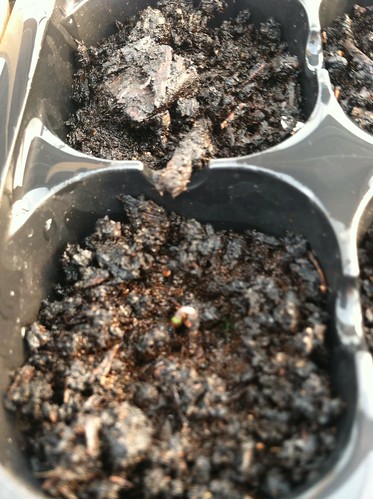
Some sprouts emerge like a sentinel, straight and proud; others, like this tomato varietal, unroll, yoga-like, as if emerging from the fetal position. Truth be told, I had essentially given up on this heirloom varietal. The small seeding cells have remained blank and austere since their late February inhabitation. Other seeds had sprouted -- though slowly -- and appear to be gaining strength. These six cells, however, remained quiet.
I had selected these seeds for more than horticultural reasons. The variety is, indeed, an heirloom; and only a few seeds were included in the tiny envelope secured in the larger package. There apparently is something special about the breed. But this particular tomato shares its name with my paternal grandmother -- Lola -- and I couldn't resist the purchase and the chance to cultivate this symbolic way of bringing her back to life.
But the weeks have passed, and the soil remained still.
Perhaps it is the past couple of warmer days that have stirred the movement; perhaps these particular seeds have taken their own peculiar time. Whatever the reason or the prompt, this afternoon the upper back and shoulders of this fragile stem broke through. By tomorrow morning I suspect it will have straightened and found its better posture. Perhaps then, a neighbor or two to join it. Indeed, in the last 24 hours the shelved neighborhood has shown considerable activity and progress.
I have often observed that it doesn't take very many birdies to keep a golfer coming back. I suppose the same can be said about sprouting seeds for a gardener.
Already I feel like coming back -- like spring might offer something promising after all.

Seeking depth and nourishing strength
Wednesday, March 27, 2013
Lola Tomato Sprout

Wednesday, March 13, 2013
The Gift of Even Tiny Signs of Life
It still seems unfathomable to me -- as ineffably mysterious as Jesus turning water into wine. How is it that those tiny seeds can become stems and leaves and edible things? I'll admit that I was losing faith. Since February 25 I have been talking, with no indication that any horticultural ears were listening. For two weeks now those compost-filled cells into which I had secreted various vegetable seeds have greeted me each morning with the same blank landscape, though I have dutifully -- albeit less and less optimistically -- sprinkled saved rain water onto their surface.

Until today. Checking back in my notes from last year's first season, the first sprouts of green emerged 12 days after sowing, with subsequent varieties appearing in successive days. Monday -- this year's comparable benchmark -- passed without even a hint of stirrings. Today, however -- day 14 -- just as I considering vegetable abortion in the interest of saving water, tiny green shoots emerged from the jalapenos and tomatillos. Looking still closer, signs of life are insinuating movements among still others of the "crop." Though it is still too early to tell what all might eventually mature and what might still fizzle beneath the soil, nature has yet again afforded me a helpful and humbling lesson in patience.
Everything in its own time.

Savoring, then, the memory of the salad we enjoyed earlier in the week from those seeds I sowed in November, and taking inspiration from these tiny nudgings of progress, I settle back down to the satisfying anticipation of a garden that just might happen this season after all.

Until today. Checking back in my notes from last year's first season, the first sprouts of green emerged 12 days after sowing, with subsequent varieties appearing in successive days. Monday -- this year's comparable benchmark -- passed without even a hint of stirrings. Today, however -- day 14 -- just as I considering vegetable abortion in the interest of saving water, tiny green shoots emerged from the jalapenos and tomatillos. Looking still closer, signs of life are insinuating movements among still others of the "crop." Though it is still too early to tell what all might eventually mature and what might still fizzle beneath the soil, nature has yet again afforded me a helpful and humbling lesson in patience.
Everything in its own time.

Savoring, then, the memory of the salad we enjoyed earlier in the week from those seeds I sowed in November, and taking inspiration from these tiny nudgings of progress, I settle back down to the satisfying anticipation of a garden that just might happen this season after all.
Wednesday, February 27, 2013
The Grace of Heavy Snow
There are, of course, occasional "special assessments" charged against this lifestyle. Not that that can't happen anywhere I suppose, but elsewhere they generally fall into the category of "emergency repair or replacement."
A leaky roof.
A cold hot water heater.
A spent furnace.
A ruptured pipe.
Here they are the presumptive, albeit unpredictable labors of remote and relatively self-contained living. Like snow removal. Two years ago, as but one household among a couple of dozen in our townhome association my only winter exertion was complaining when the hired road and sidewalk crew didn't arrive as early as I wanted them to. That, and an occasional hike up the entrance road when my car couldn't find the traction to best the icy incline and had to be parked down below. Now five miles out of town on county roads, the last third unpaved, I am that crew -- with no one to complain about but myself.
 But we prepared. A large hydraulic snowblower attachment replaces the lawn tractor's mowing deck in the winter, and we have gradually accumulated appropriate shovels and pushers, along with the thermal outerwear to encase us while using them. And I'll admit that at 5:30 a.m. I had other things on my mind than snow removal -- especially since I had just accomplished it all pretty thoroughly yesterday. As it turned out, however, yesterday's 7-inch snow was only the beginning, never mind the alluring pause that seduced me into thinking the storm had passed. The early hour notwithstanding, Lori needed to get to work, and though I had no influence on county plows that would be needed on the longer stretches of road, the driveway was in my job description. And the front porch and sidewalk -- 3 separate times now by this point in the day.
 Strangely, however, I don't mind the effort. There is something almost meditative about the throbbing engine, maneuvering the tractor through the accumulated layers, aiming the plume of snow in harmless directions and mechanically painting a clearing through which the cars can pass. The hand tools leave a clear record of accomplished good. More importantly, after more than a year of drought I look at the snow as a gift to celebrate rather than a hassle to curse. Though the experts in such matters caution that it will be almost impossible to fully recover moisture levels by summer, I figure every little bit helps. In the same way that hog farmers sniff the stench and report that it "smells like money," I look at these 12-14 inches of snow and observe that "it looks like irrigation."
The sky is brightening, and nothing seems to be falling. The storm seems to have passed, though I've left the shovels on the front porch just in case I've been deceived again. It's true that my muscles are hoping they won't be needed for awhile, but I feel a certain melancholy about the calm. It's nice to be "dug out," and the road crews deserve a chance to catch up and then take a break. But there has been something profoundly gratifying about this price I get to pay for the deep privilege of living here.
A leaky roof.
A cold hot water heater.
A spent furnace.
A ruptured pipe.
Here they are the presumptive, albeit unpredictable labors of remote and relatively self-contained living. Like snow removal. Two years ago, as but one household among a couple of dozen in our townhome association my only winter exertion was complaining when the hired road and sidewalk crew didn't arrive as early as I wanted them to. That, and an occasional hike up the entrance road when my car couldn't find the traction to best the icy incline and had to be parked down below. Now five miles out of town on county roads, the last third unpaved, I am that crew -- with no one to complain about but myself.
 But we prepared. A large hydraulic snowblower attachment replaces the lawn tractor's mowing deck in the winter, and we have gradually accumulated appropriate shovels and pushers, along with the thermal outerwear to encase us while using them. And I'll admit that at 5:30 a.m. I had other things on my mind than snow removal -- especially since I had just accomplished it all pretty thoroughly yesterday. As it turned out, however, yesterday's 7-inch snow was only the beginning, never mind the alluring pause that seduced me into thinking the storm had passed. The early hour notwithstanding, Lori needed to get to work, and though I had no influence on county plows that would be needed on the longer stretches of road, the driveway was in my job description. And the front porch and sidewalk -- 3 separate times now by this point in the day.
  Strangely, however, I don't mind the effort. There is something almost meditative about the throbbing engine, maneuvering the tractor through the accumulated layers, aiming the plume of snow in harmless directions and mechanically painting a clearing through which the cars can pass. The hand tools leave a clear record of accomplished good. More importantly, after more than a year of drought I look at the snow as a gift to celebrate rather than a hassle to curse. Though the experts in such matters caution that it will be almost impossible to fully recover moisture levels by summer, I figure every little bit helps. In the same way that hog farmers sniff the stench and report that it "smells like money," I look at these 12-14 inches of snow and observe that "it looks like irrigation."
 The sky is brightening, and nothing seems to be falling. The storm seems to have passed, though I've left the shovels on the front porch just in case I've been deceived again. It's true that my muscles are hoping they won't be needed for awhile, but I feel a certain melancholy about the calm. It's nice to be "dug out," and the road crews deserve a chance to catch up and then take a break. But there has been something profoundly gratifying about this price I get to pay for the deep privilege of living here.
Monday, February 25, 2013
A Blessing Prayer of Evening
As of today it has officially begun. Fully a week earlier than last year I began to sow the seeds of summer. Yes, the move is partly impatience. The packets of seeds, ordered and delivered weeks ago, were indeed burning a hole in my closet where I had secreted them away out of Tir's canine reach. I was anxious to get started. But there is more to the progress than that. Backing up from my anticipated garden opening in early-to-mid May, several of the seeds prefer that much time in the greenhouse. Additionally, I intend to be smarter about staging the transplanting over a period of weeks to spread any hypothetical harvest. All that, and those that are truly on the early side will have enough time to germinate and show themselves with adequate time remaining for replanting those that prove to be only shooting blanks.
There was, of course, more to it than simply dirt. First there had to be electricity reconceived after a year's disassembly. There are warming lights to power beneath the trays, and growing lights suspended above. The former need to always be on, while the latter need a timer's intervention. The heater went back in at least for these early weeks, and it needs it own electrical consideration. Engineering is not my forte, but tonight's gala premier inspection evidenced a successful installation until it all blows a fuse.
After heating the barn, setting up work tables and organizing the packets by timing I tore open the first bag of compost and scooped full the trays. Finally, with a deep breath and a steady hand, I nestled the tiny portents of life into their temporary home and shuttled the filled cells next door and onto the greenhouse shelves.
I wouldn't presume to know the silent broodings of a woman when she first confirms that she's pregnant, but I suspect there are both giddy anticipations and wordless fears -- of all that flourish and all that could endanger beyond the opaque curtain of that which is to be for this that is still barely more than a seed. And I wouldn't presume to equate those stirrings of natal life with composted tomato seeds. But, still, as I checked the lights and misted the surfaces and cast an evening's final glance along the shelves, it was a prayer that spontaneously rose as the door latched behind me.
An invocation of sorts.
A blessing prayer for nourishment, safety and, yes, growth.
There was, of course, more to it than simply dirt. First there had to be electricity reconceived after a year's disassembly. There are warming lights to power beneath the trays, and growing lights suspended above. The former need to always be on, while the latter need a timer's intervention. The heater went back in at least for these early weeks, and it needs it own electrical consideration. Engineering is not my forte, but tonight's gala premier inspection evidenced a successful installation until it all blows a fuse.
After heating the barn, setting up work tables and organizing the packets by timing I tore open the first bag of compost and scooped full the trays. Finally, with a deep breath and a steady hand, I nestled the tiny portents of life into their temporary home and shuttled the filled cells next door and onto the greenhouse shelves.
I wouldn't presume to know the silent broodings of a woman when she first confirms that she's pregnant, but I suspect there are both giddy anticipations and wordless fears -- of all that flourish and all that could endanger beyond the opaque curtain of that which is to be for this that is still barely more than a seed. And I wouldn't presume to equate those stirrings of natal life with composted tomato seeds. But, still, as I checked the lights and misted the surfaces and cast an evening's final glance along the shelves, it was a prayer that spontaneously rose as the door latched behind me.
An invocation of sorts.
A blessing prayer for nourishment, safety and, yes, growth.
Friday, February 22, 2013
The Fence's Centering Grace

Still, I am glad I left it in place. Absent that visual circumference, the garden would have disappeared into the snow-covered prairie; merging with the expanses of tall grass laid down by the burdens of the cold. I like glancing out the window and tracing with my eyes that demarcation anchoring our lives in this place and beckoning us forward toward the coming season's next lessons in the classroom of growing food. Set apart out there is the reason we came. I recall the packets of seeds already arrived and waiting their turn in this great and wondrous horticultural dance. I note the apprehension lingering just below my consciousness, whether last year's asparagus plants and berry bushes survived the heat and the drought to emerge stronger into this season's offering, whether the fruit trees, barely adolescent, will produce a crop, and whether my soil preparations last fall will make a difference.
The days are growing longer -- the sun flexing its muscles toward spring and warming up for the marathon of summer. Seeding time is nearing as attention shortly turns to the greenhouse and its fragile incubation. The compost has long since been ordered and delivered, and the seed trays are restless to be filled. A new cultivating tool is scheduled to arrive tomorrow. The layout is designed online and awaiting its actualization. Already my psyche wanders about italicized, leaning forward toward the tilling and the tending. But the days are not here just yet. Last night fell six inches of snow with more predicted in the coming days. A crystalline white blanket "shushes" the acres into quietness, reminding them -- and me -- that winter has not finished with us yet.
But over the whiteness the sagging fence line whispers, in tones I perhaps only imagine that I hear, that it won't be all that long before squash is on the vine, beans are on the bush, and roots, deeply reaching, are drinking in all the goodness they can find.
So let it snow. The fence will keep me centered.
Monday, February 4, 2013
Looking, and Being Willing to See
It is owing to our limitations that a thing appears to us as single and separate when in truth it is not a separate thing at all. -- Rudolf SteinerIt's hard to say at this point if the inexorable reductionism of scientific inquiry has warped us this way, or the cultural mythology of "rugged individualism" that is the water we swim in. Regardless, here we drift along in the current of this delusion of autonomy.
Seeing ourselves as separate.
Seeing all things as disconnected.
And pretending that it is somehow noble and good.
But it is delusion. Just because a baby holds his hand across his eyes to obscure the field of vision doesn't mean his mother isn't present only inches away. And just because I can't -- or won't -- see the connections weaving all of creation into interdependence doesn't mean those very real connections aren't at work.
Steiner, writing and studying in Germany in the early 1920's and often called the "Father of Bio-Dynamics", advocated a system of farming that is spiritual-ethical-ecological. Preparing, planting and tending honor and seek to maintain a "diversified, balanced farm ecosystem that generates health and fertility as much as possible from within the farm itself," incorporating preparations "made from fermented manure, minerals and herbs are used to help restore and harmonize the vital life forces of the farm and to enhance the nutrition, quality and flavor of the food being raised" (Biodynamic Farming and Gardening Association). These seemingly quirky preparations, coupled with the fact that bio-dynamic practices follow the phases of the moon, helps explain why the method is often dismissed as so much "voodoo." But no one accuses the ocean of witchcraft because currents and waves are influenced by the moon. Why should plant fluids moving up and down the stem be exempt?
Or the beneficial fungal and bacterial activity feeding roots in healthy soils?
Or the pollinating assistance of bees?
Or the leaf's capacity to convert sunlight to energy?
Or the human body's ability to convert a pea or a tomato or a carrot or a beat into nourishment?
And that's just in the garden and the gut. Who can imagine the connections that are pulsing through a healthy community, whether we can see them or not?

Might we eventually learn that uniqueness and connectedness are not enemies, but essential and reinforcing blessings within the phenomena of grace -- and the resilience of such a web is a gift rather than a burden?
Perhaps this day I might lower my hand long enough to see one more expression of the connectedness that was gloriously present all along.
Monday, January 21, 2013
Paying it Back or Paying it Forward, in This Case It's All the Same
"Soil fertility is the condition which results from the operation of Nature's round, from the orderly revolution of the wheel of life, from the adoption and faithful execution of the first principle of agriculture -- there must always be a perfect balance between the processes of growth and the processes of decay. The consequences of this condition are a living soil, abundant crops of good quality, and live stock which possess the bloom of health" (Sir Albert Howard, An Agricultural Testament, 1940, p. 38).Perfect balance. That sounds like an awfully high expectation, and one requiring a weighing hand significantly above my pay grade. Whether it's diet and exercise, meat and vegetables, work and play, public life and private time, or simple waking and sleeping, "perfect balance" doesn't seem to be my natural effluence. Like biscuits and gravy, the proportions never seem to come out even.
Still, Howard's maxim is worthy contemplation. I have always thought of decay as one of life's little negatives -- the inexorable descent of organic matter (like bananas, lettuce, and people) into rot beyond which is simply garbage. Or grave. It's what I would have described as the "loss" of spoilage, and the race to enjoy before it happens. But of course Sir Howard's characterization is more accurate. Writing before the post-war capitulation of agriculture to the chemical industry, he recognized that healthy living has a circular dimension undergirding the glitzier linear one. Decay is simply the credit side of nature's ledger, covering the fruitful debits. Trees withdraw nutrients from the soil through their roots and then return it in the leaves they drop. Animals extract from the earth by grazing, and replenish the earth by... Well, you get the idea. Take out; put back. The symmetry, he's arguing, is essential.
And I understand. I'm familiar with the issue of expense outpacing income -- of taking out more than is put back in. We find all kinds of ways to circumvent the consequences, but the balance sheet remains. I'm coming more and more to believe that anhydrous ammonia, sprayed as "fertilizer" by the tons on our farmland, is the credit card of "modern" agriculture on which we only ever pay the minimum balance. Our essential indebtedness is unaffected -- in fact it is quietly but exponentially compounded -- but "look, Ma, at all the great new stuff I've bought!" As with our crowded houses, our fields are full of great looking stuff that we can't really afford.
We are taking out more than we are putting in -- buying more than we are paying for -- but we don't see it because Earth's bill doesn't soberly confront us monthly in the mail. And we convince ourselves that we are solvent.
But the soil is not deluded. If it is to feed us, Howard concludes, we'd best pay better attention to feeding it. It is the "please" and "thank you" of the ecosystem; washing the dishes after enjoying the dinner.

I suppose I'm learning about composting just in time.
Subscribe to:
Posts (Atom)