Wednesday, July 30, 2014

Abundance Present and Future Perfect

"Where I live, summer's keynote is abundance.  The forests fill with undergrowth, the trees with fruit, the meadows with wild flowers and grasses, the fields with wheat and corn, the gardens with zucchini, and the yards with weeds.  In contrast to the sensationalism of spring, summer is a steady state of plenty, a green and amber muchness that feeds us on more levels than we know.  Summer is the season when all the promissory notes of autumn and winter and spring come due, and each year the debts are repaid with compound interest."   -----From an essay by Parker Palmer, "Summer"
 Yesterday was a watershed day.  The two Red Star hens, determined since their arrival in early May to sleep by themselves in the coop annex, finally condescended to join the others in the larger and much fancier main coop.  I have no idea what finally flipped their switch, but assuming a continuing pattern it will be much easier on guest flock attendants in the future to only service the one location.  Since several of the hens prefer to lay eggs in the humbler quarters, I did open the annex this morning just to see what other behavioral patterns may be continued or retired, but hopefully we have finally become one happy poultry family -- residentially if nothing else.

And yesterday saw the first harvest of ripe tomatoes.  As if they, too, resolved that it was finally time to come home, fully a dozen announced themselves "ready."  I have no wish to denigrate the rest of the garden -- the long bean pods dangling from the vines; the potatoes and carrots and beets quietly maturing underground -- but ripened tomatoes are the garden's celebration analogous to the cacophonous burst of fireworks at the end of the 4th of July show.  Red and yellow and purple and black, they are what we have been waiting for -- longing for; hungering for -- ever since we first broke garden ground.

Tomatoes, then, meaning no offense to the continuing avalanche of cucumbers and squash and lettuce and braising greens that have sustained through the wait, along with a new handful of red okra spears and purple tomatillos, plus several Ancho chiles that hopped into the harvest hod as well. 

It is, indeed, a profligate time when, as Palmer notes, this season redeems with interest the promissory notes of the other three.  Add to the garden haul close to a dozen eggs a day from the chickens and it's harder and harder to keep up. 

And there is the grass.

And the weeds.

Only experience cautions that all the excitement is only for a time.  As if to forestall the inevitable, today I planted the seeds of the second crop -- delicata squash, butternut squash, a fresh round of kale, two different collard greens, spinach in two varieties, kohlrabi, brussels sprouts, parsnips and edible pumpkins.  Sowing, to trick winter into thinking that summer is still ascendant.  It's true that I may never see the fruits of these labors.  Autumn's length is unpredictable.  An early freeze could punish my attempts at deception and burn them all back.   But in the midst of summer's abundance, hope springs eternal.

And in the meantime, we simply smile as the juice trickles off our chin.


Sunday, July 13, 2014

Inconvenient Work and the Fruits of our Labor

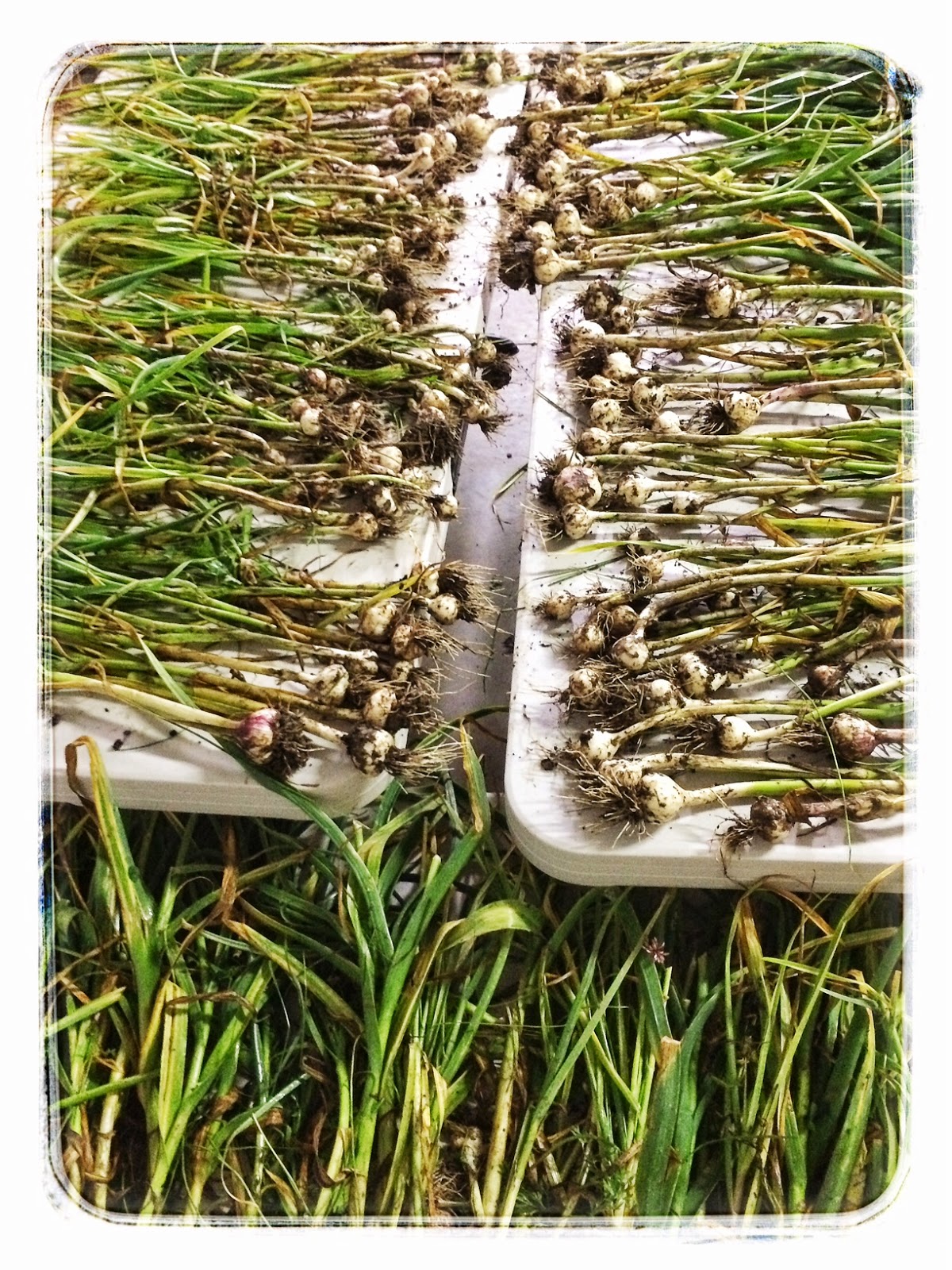
November's graying chill seems a long time past from July's midsummer warmth and sun.  Surrounded by green tomatoes, squash blossoms, fanning leaves and towering stalks, that end-of-the-season weariness and agricultural dishevelment would scarcely be a memory were it not for the garlic.  Garlic is a crop of the will, not the heart.  At the very time of year when, after a summer and fall of answering the garden's every beck and call, one could be forgiven for wishing it to bed, garlic demands yet another sojourn with the tiller in order to beat winter's hardened earth.  You have to beat the snow or you will never find it room.

We did, of course.  Ten rows of multiple varieties.  Covered with compost and straw, they over-wintered until poking through their springtime sprouts.  By late June we were clipping the scapes, driving all their energy to the maturing bulbs, and this week the yellowing leaves signaled their time. Friday, then, after a gentle morning rain had eased the soil, we pulled.

And pulled.

Drying now in the barn, the tables full of bulbs and their secreted cloves conjure up anticipatory tastes of marinara and salsa and guacamole and who knows what other culinary delights.

In the meantime, securely protected from any ill-intended vampires who might otherwise have cast a hungry eye toward rural Warren County, I think again of the value of doing what you need to do, when you need to it, no matter how wearisome the labor might sound.  Because later on, the reward smells like heaven.  The taste of it, I have to imagine, will as well.

Thursday, July 3, 2014

Broken Stems and Resolute Spirits Chastened by Mother Nature

On the way home from school one day shortly after moving to Des Moines my son was set upon by a handful of tougher classmates.  Perhaps it had to do with his accent that sounded bizarrely out of place.  Perhaps it was his clothes that reflected a different culture's sense of style.  Perhaps it had to do with his becoming a link in a chain of friendships they didn't feel he belonged.  Whatever, he arrived home late with a few bruises, some torn clothes, and a demoralized spirit.  It was heartbreaking.  The injuries were superficial, but the affront was severe.  First frightened, then angry, we quickly became over-protective -- thrashing about for some kind of bullet-proofing bubble.

Those hours came to mind Tuesday morning as Lori and I surveyed the garden following the previous afternoon's storm.  Black as night at 2 pm, the rains had hammered hard -- two inches in an hour -- the hail had peppered, and the winds -- hurricane force according to the National Weather Service -- had blown.  It was not a good combination for a garden swelling with promise and green fruit.  Walking among the rows we found broken stems, shredded leaves, scattered baby tomatoes, and once-proud stalks sadly horizontal.  It looked like a Civil War battlefield the day after combat.  Anger, heartbreak, a sense of helpless resignation, I wondered what among the carnage might revive.  That, and of course that over-protective reflex.  Having already raised a deer fence reinforced against rabbits, I couldn't help but wonder what additional precautionary measures might be available.  Perhaps some horticulture version of a bullet-proof vest.

In the end we simply got down on our knees and pulled weeds and encroaching grass.  It felt like care-taking.  It wouldn't repair any of the brokenness, but at least we could make the injured more comfortable.  That, and allow ourselves to steep in the reality that we can only do what we can do in the face of all those other eventualities about which we can finally do nothing.  As Lori likes to note, "this is, after all, nature."  Wild, capricious, sometimes-nourishing, sometimes-dismantling, always-humbling nature -- a grace and a force of which we are not in charge.

Tuesday, June 17, 2014

The Sleeplessness of Negligence Followed By a Morning of Grace

We had been busy after all.  Aware that bad weather was predicted, I had attacked the overgrown grass in the dog run, trimmed a little more in the garden, pulled some extra weeds, restocked the chickens' feed and water, then got busy with some inside business.  By the time Lori got home the sun was setting and dinner yet to prepare.  Shortly thereafter, sated and weary, we stacked dishes in the kitchen sink, took the dogs out one more time and shuffled off to bed.  It wasn't until the storm was erupting in all its violent splendor that I realized I hadn't cooped the chickens.  And admitted with comfortable shame that I wasn't willing to crawl out of bed, dress and venture out into the tornado-warned and rain-drenched thunder and lighting and high winds to see that they were secure.

The main coop, I was confident, would be OK.  It has a long and low profile with a curved silhouette.  Its doors were open and I worried over possible predators, but I hoped the electric fence would provide some insurance; hoped as well that the storm would incentivize their absence as much as it did mine.  And hoped that most of the rain would be kept out.  It was the annex that concerned me.  Stationed nearer the fenceline, I was concerned that it might offer a more proximate temptation for the venturesome hungry.  At a more basic level I was concerned that the high winds could even topple it.  That, and the chicken door opens on the north face, straight into the wind and the rain.  An elevated roost would offer some remove from a soupy floor -- the nesting boxes above even more.  But I fretted about fright and soggy feathers, and cursed my inattention.

When the dogs nudged me awake at their usual pre-light hour, I took them out and then stood sentry in the sunroom waiting for whatever first light might reveal.  As black gave way to gray I could make out the outline of the fence and see that it was still intact.  Nothing had breached the perimeter.  And then movement out of the corner of my eye.  Unconfined, the hens were already out bantering around the chicken yard, busily searching for surfacing worms.  I dared to count and everything tallied.  All seemed well, and like teenagers whose parents are out of town, strutted their emancipation.  They were coming and going as they pleased.  As is common when I'm watching them, I laughed; and sighed with relief.

Later, breakfasted and dressed, I surveyed the condition of the coops.  As I had anticipated, the main coop was fine.  The run was understandably soggy, but the sleeping quarters were high and dry.  My surprise came with the annex.  Not only was it upright, exactly how I had left it, it was, like its fancier neighbor, dry and comfortable.  The feed dispenser and waterer were both empty, as though the two Red Stars had partied through the storm, but other than that all was perfectly in order.  Given my twilight worrying, I almost begrudged them their serenity.  Almost.  I refilled their provisions and penitentially layered in more pine shavings to bolster their bedding.

More storms are in the forecast, and I am happy for any additional rain; but despite last night's happy ending I will be more diligent tonight.  The coop doors will be closed and latched, with the chickens safely bedded and battened down inside.  And with any luck, I will sleep in peace.

Wednesday, June 11, 2014

The Garden as Social Classroom

The Galapagos Giant Land Tortoise lives up to its name.  A dining table-sized reptile, it lumbers through the tropical fields at a leisurely pace -- stopping more than going, as if enjoying the view or, more likely, scoping out its next grassy bite.  Enjoying the sun, it stretches out its long neck as an offering to the finches and mockingbirds who lunch on the irritating bugs and parasites that take up residence within the fleshy folds.  Both the tortoise and the bird enjoy the mutual benefit -- a private food supply for the latter, and a comforting cleansing for the former.

Various indigenous tribes of North America commonly employed an agricultural parallel to this symbiosis.  Among the early plants domesticated for their nutritional and culinary value, corn and beans and squash became dietary staples on the table, and siblings in the garden.  Early gardeners discovered that these "Three Sisters" offered to each other mutual benefits.  Beans fix nitrogen in the soil on which the corn hungrily depends, corn stalks provide a trellis on which the beans can climb, and the prickly stems and sprawling leafy stems of the squash provide a pest-deterring, moisture shading ground cover.  Each party brings something to the enterprise, and everyone benefits.

Trying my luck for the first time this summer with some Wachichu Flint Corn I thought to give the Three Sisters a try.  My bean attempts in the past have resulted in underwhelming harvests.  My squashes have fared better, to the extent that I could barricade the bugs.  If their independent mediocrity could be improved by companionship I figured it was worth the try.  We'll see how it goes.  I was over-eager in my planting -- sowing the seeds within days of each other.  Additional research tells me I should have started with the corn to allow its stalk to get a head start before adding the siblings, but I am hopeful.  So far all seem to be thriving in each other's company, although the corn will have to hurry if it is going to offer much of a climbing pole.

There are other such companionships.  A book I have recently acquired on the subject is titled Carrots love Tomatoes and Roses love Garlic -- presumably telegraphing some of its offered suggestions.  Elsewhere I have read of interplanting dill with the tomatoes as a kind of natural pest deterrent.  I intend to try that as well.  We could stand some better role models of such interdependence.

I would like to think that the Palestinians and Israelis, gays and straights, "reds and yellows, blacks and whites" could discover similar synergies that would transform their differences into mutually recognized benefits, but I suppose that enlightenment is still some miles further down the road.

In the meantime, the Three Sisters, the tortoises and the birds will have to steadfastly set an example.

And we think we are the more enlightened, higher species.

Monday, June 9, 2014

A Lot to Go Through for a Song

The baton has been tapped and the symphony has officially begun.   The players are the 17-year cicadas that have emerged in full force, and though the instrumentation is a bit narrow -- something like an oboe on steroids -- it's really quite an impressive sound.  Truth be told, it's almost deafening; a wave-like undulation of varying intensities.

We had fair warning.  The media had earlier put us on alert, but I'll confess to inattention.  Then, Saturday morning, while walking outside with the dogs, Lori was troubled by the witness of an apparent beetle infestation of almost biblical proportions.  Rushing back inside, she tore into Google Images trying to identify the beetle at hand.  "They are everywhere," she noted with alarm and obvious concern for the garden.  Unsuccessful with the internet, she nudged me outside to have a look. 

Closer inspection betrayed the truth.  It was true:  they were everywhere.  Dozens on virtually every grassy stem.  According to news reports, a single tree can bear up to 40,000 -- 1.5 million per acre.  No wonder Lori's first concern was the garden.  Plague-like, all that was missing was Cecil B. Demille, Moses and the Egyptian Pharaoah.  Or maybe Alfred Hitchcock.  Anyone the least bit arachnophobic would have readily labeled it a horror movie.  But there was also fascination.  Harmless, now that we recognized what they were, we could accede to closer observation -- and fascination.

The "beetles" were in reality the exoskeletons from which the cicadas were emerging.  Pale green and almost translucent, the newly liberated insects dried themselves on the tall grass stems, defenseless, and offered themselves up to the gods of transformation.  By mid-day they had grown to a two-inch body size and found their adult colors -- orange veins and big red eyes. By mid-afternoon the music had begun -- the males trying their aural best to attract feminine attention.  They have my sympathy.  I've been to junior high dances.  It's tough enough to get yourself noticed when you are simply one among a few dozen competitors.  I can't imagine what it's like for the poor cicada.  At least we could try out an interesting dance move.  All these guys have is a single instrument identical to the ones that everybody else in the tree is playing.  Volume seems to be the only variable virtuosity.  By evening they were venturing their first flight.

They will be gone in a handful of weeks.  By then we will be deaf or inured to the sound.  Then the troops will once again march under ground until their next concert in 2031.   I doubt I will miss them -- the sound, but also the concentration.  Even knowing what they are and their harmlessness, the sheer numbers are a little creepy.

Still, it's impressive what all they go through -- 17 years underground, a climb up into the open, bursting out of a shell, drying off and stretching their wings -- just to make a little music.  So to speak.

Good luck, little guys.  I'm pulling for you.

Wednesday, June 4, 2014

Where the Heart Is

Home.  Some describe it in relational terms -- "where, when you go there, they have to take you in," according to Robert Frost.  For Dorothy, there was "no place like home," and there would be no relief until she could physically return there.  Emily Dickinson took the opposite view -- that "where thou art, that is home."  But for at least two of the chickens, Pliny the Elder got it right:  "home is where the heart is."  And their heart is very specifically located.

It started a month ago when the two Red Stars arrived.  Following conventional wisdom I settled them into the coup annex -- that modest secondary structure located in the general vicinity of the primary coop, but separated by mesh fencing to protect the new arrivals from pecking order battles that can mount into deadly escalations.  The idea is for the settled hens to become familiar with the new neighbors long enough to forget that they haven't always been together.

The requisite two-weeks passed and I introduced the Stars to the larger flock.  Afternoon passed without incident, but that evening as everyone was drifting inside the run, Lori noticed that one of the Barred Rocks was roughing up the smaller of the two Stars.  She heroically intervened and reestablished the previous segregation.  In subsequent days I united the flock during daylight hours, but returned the Red Stars to their annex for roosting.

Now weeks later, that's where it stands.  Days are spent in united free-ranging, but as darkness approaches the division emerges -- the older nine ascend the ramp into their coop, while the newer two drift over to the edge of the fence line near the annex and wait for me to help them home.  Safety is no longer the issue -- they are all perfectly happy in each others company.  Rainstorms have sent them all running amiably for common shelter.  They share the same food and water and nesting boxes.  They scurry around happily side by side most of the day.

Then it is as though dusk blows some kind of a whistle.  Regardless of the day's events, nightfall sends the older hens up and the newer hens over -- quite literally over the fence -- with help.  The two follow me over to the edge and squat, waiting for me to pick them up, one by one, and drop them into their own little corner of their own little world.

I'll admit that it's sweet.  I will also acknowledge that it's tiresome.  We'll be sitting on the deck, enjoying the free entertainment of the 11 pecking their way around the enclosure when, as if on a signal, the two groups move in their separate directions.  The Stars kindly but assertively look our way, as if to say, "We'd like to go to bed now."  And I comply.

It could, I suppose, be the residue of traumatic memories -- a kind of Freudian imposition of unspoken boundaries.  But I don't think so.  By all appearances they are content in each other's company.  And then there are those who locate responsibility squarely at my feet.  I have been complicit, they argue, in patterning a habit the hens are now unwilling to break.  To some extent, I'll concede their point.  I am an indulgent flockster.  Those who have observed this have noted that in their second life they would like to come back as one of our chickens.  Fair enough.  I'm an enabler.


But I am convinced there is more to it than mere routine.  More than memory; more than habit, I rather believe, as Pliny surmised, it has something to do with the location of their heart.  It's as though they are saying, "we'll spend our days in whatever way makes sense -- in wild adventure or pursuit of basic sustenance, in deep contemplation or lively social engagement -- but at the end of the day we'd prefer to simply go home.  Where our comb-headed, feathery little heart is."

Which, come to think of it, sounds a lot like me.

So, I suppose I am good with it.  But it sure would be nice if I could teach them to close their eyes, click their heels together and cluck something like, "There's no place like the annex..." and miraculously be there without my assistance.

But I doubt the ruby slippers would fit their little claws.